

Are you thinking about joining the thousands of Indian entrepreneurs setting up shop in Dubai? If you want to know how to start a business in Dubai from India, you’ve come to the right place. People love Dubai for its great location, easy business rules, and low taxes that help you connect with global markets.
This guide is your complete roadmap for 2025. We will walk you through the different legal structures for your company. You will also learn about the updated tax laws, how to get your visa, and what you need to do to stay compliant after opening.
How to Start a Business in Dubai from India? A Step-by-Step Guide
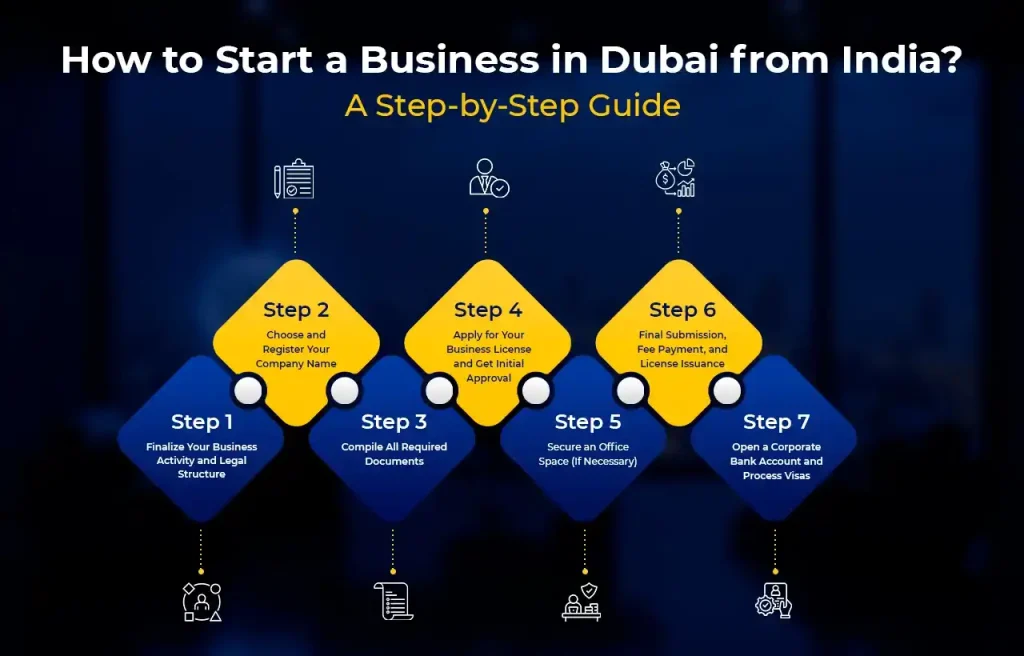
Step 1: Finalize Your Business Activity and Legal Structure
First, you need to pick what your business will do. Your company formation in Dubai begins with this choice. The Department of Economy and Tourism (DET) has a list of over 2,000 business activities you can select from.
This decision will guide the type of license you get. You will also choose a legal structure for your company, whether it’s on the Mainland, in a Free Zone, or Offshore. We will explain these options in the next section.
Step 2: Choose and Register Your Company Name
Next, you will pick a name for your business. The UAE has specific rules for naming a company. Your chosen name cannot be offensive or use religious words. It must also be unique and not already taken by another business.
If you use your own name, it must be your full name, not just initials. After picking a name, you must check its availability and get it approved by the correct authority.
Step 3: Compile All Required Documents
Now it’s time to gather all your paperwork. Preparing the right documents is a key part of your Dubai company setup. Here is a simple checklist of what you will usually need for your business registration in Dubai:
- Passport copies for all business partners and directors.
- Your visa and Emirates ID copies, if you are already a UAE resident.
- A business plan, which some free zones or specific activities require.
- Your company’s Memorandum of Association (MOA) and Articles of Association (AOA).
- Attested proof of your address and reference letters from your bank.
Step 4: Apply for Your Business License and Get Initial Approval
With your documents ready, you can apply for your business license. You will submit your application to the correct authority. For a mainland company, this is the Department of Economy and Tourism (DET).
If you chose a free zone, you will apply to that specific free zone’s authority. After they review your application, you get an “Initial Approval”. This is the government’s first green light, confirming they have no objection to your business and allowing you to move to the next steps.
Step 5: Secure an Office Space (If Necessary)
Your business in Dubai needs a physical address to operate legally. For a mainland company, a registered office space is mandatory, and you must have a registered lease contract, known as an Ejari. Free zones offer more flexible choices to suit your needs. You can pick from options like flexi-desks, which are shared workspaces perfect for startups, or rent a dedicated physical office. The type of office you choose often depends on the number of visas you need for your business setup in Dubai.
Step 6: Final Submission, Fee Payment, and License Issuance
You are now in the final stage of getting your company license. You will need to sign your company’s Memorandum of Association (MOA), often in front of a notary. After that, you pay all the required fees for your license and registration. Once the payment is complete and all documents are verified, the authorities will issue your official trade license. This license is the legal document that allows your company to start operating in Dubai.
Step 7: Open a Corporate Bank Account and Process Visas
Once your company is officially registered and you have your trade license, the next steps are to manage your finances and residency. You will need to open a corporate bank account in the UAE. This is necessary for handling all your business transactions. After that, you can apply for your investor visa, which gives you residency. You can also start the process of getting visas for any employees you plan to hire for your new venture in Dubai.
Source: The information presented here is based on guidelines from business setup consultants and official government portals like Invest in Dubai, and the UAE government’s official site, as reflected in the cited sources.
Mainland vs. Free Zone vs. Offshore: Which is Right for Your Business?
Choosing where to set up your company is a big decision when you plan a business in Dubai. You have three main options, and each one works differently. Understanding them helps you pick the best fit for your company registration in Dubai.
Dubai Mainland Company
A mainland company gives you the freedom to do business anywhere in the UAE and with any customer, including government offices. You can open branches across the Emirates without any limits. However, the setup costs can be higher, and some professional activities might require you to have a Local Service Agent.
UAE Free Zone Company
In a UAE free zone, you can own 100% of your business without a local partner. You also get benefits like 0% corporate tax if you meet certain conditions and can take all your profits back home. The UAE has over 50 free zones, but your business activities are usually limited to within the zone or outside the UAE.
Offshore Company
An offshore company is mainly for international business, protecting your assets, or optimizing taxes. You can have a corporate bank account and enjoy full privacy. The main limitation is that you are not allowed to do any business directly within the UAE market or rent a physical office space.
| Feature | Mainland Company | Free Zone Company | Offshore Company |
| Ownership | Up to 100% foreign ownership for most activities | 100% foreign ownership | 100% foreign ownership |
| Business Scope | Can trade anywhere in UAE and internationally | Trade within the zone and internationally | Only outside the UAE |
| Office Requirement | Physical office is required | Flexible options (virtual, flexi-desk) | Not permitted |
| Visa Eligibility | Yes | Yes | No |
| Auditing | Mandatory | Mandatory for most zones | Varies by jurisdiction |
The Real Cost of Setting Up a Business in Dubai
Understanding the costs helps you plan your budget for your Dubai business venture. The total amount depends on your license type, location, and other choices. Here’s a look at what you can expect to pay.

Breakdown of One-Time Setup Costs
Getting your business started involves several initial payments. The biggest one is the trade license fee. For a mainland company, this can range from AED 15,000 to AED 35,000. If you choose a free zone, the costs are often lower, with packages starting from around AED 12,900.
You will also have smaller fees to think about. There are nominal charges for initial approval and name reservation, which can be around AED 1,000.
Another cost is for notarization and attestation, which involves paying to get your official documents legally verified. These one-time costs are the first step in your company formation journey in Dubai.
Breakdown of Ongoing Annual Costs
After the initial setup, you have annual costs to keep your business running. The most important one is your license renewal, which you must pay every year to keep your company legal. This can cost between AED 10,000 and AED 20,000 depending on your license and authority.
You will also need to budget for office rent. A flexi-desk in a free zone might cost between AED 15,000 and AED 20,000 annually.
A small physical office on the mainland can start from AED 40,000 per year. Visa costs are another recurring expense. An investor visa can cost between AED 4,000 and AED 7,000, with similar fees for employee visas.
Finally, you may have fees for PRO services to handle paperwork and compliance filings like VAT or ESR.
Legal & Financial Compliance For Business Setup in Dubai in 2025
Once your business is set up, you need to follow certain rules to operate smoothly. This includes understanding taxes in the UAE and fulfilling your obligations as an Indian investor. Keeping up with these legal and financial duties is a big part of your business journey in Dubai.

UAE’s 9% Corporate Tax: A 2025 Update
The UAE has a corporate tax system that you need to know about. If your business’s profit is more than AED 375,000 in a year, you will pay a 9% tax on the amount above this limit. Profits below this amount are taxed at 0%.
Some companies, especially those in free zones that meet specific “qualifying income” conditions, can still get a 0% tax rate. This tax law helps the UAE align with global standards while keeping the environment business-friendly.
The India-UAE Double Taxation Avoidance Agreement (DTAA)

As an Indian entrepreneur, you benefit from a special agreement between India and the UAE called the Double Taxation Avoidance Agreement (DTAA). This treaty makes sure you don’t pay tax on the same income in both countries.
It covers things like profits from dividends and capital gains. The DTAA clarifies which country has the right to tax your income, preventing financial confusion and helping you save money. This makes your UAE company registration from India much more attractive.
RBI & FEMA Compliance: A Checklist for Indian Investors
When you invest money from India to start your Dubai business, you must follow rules set by the Reserve Bank of India (RBI) under the Foreign Exchange Management Act (FEMA). This is managed through the Outward Direct Investment (ODI) framework.
You are required to submit certain forms to the RBI through your bank in India to report the investment. You also need to file an Annual Performance Report to show how your overseas company is doing. Following these steps keeps your investment compliant with Indian laws.
Your Post-Setup Compliance Calendar
After your business is running, you have a few regular tasks to stay compliant. Think of it as a yearly checklist for your company. Here are the key things you’ll need to manage:
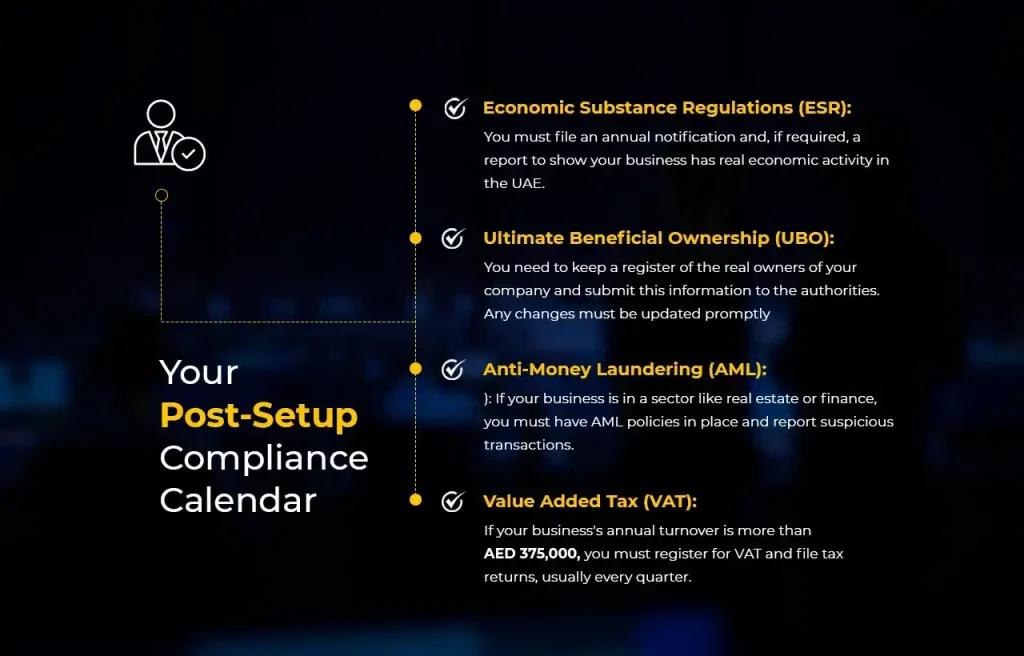
Economic Substance Regulations (ESR): You must file an annual notification and, if required, a report to show your business has real economic activity in the UAE.
Ultimate Beneficial Ownership (UBO): You need to keep a register of the real owners of your company and submit this information to the authorities. Any changes must be updated promptly.
Anti-Money Laundering (AML): If your business is in a sector like real estate or finance, you must have AML policies in place and report suspicious transactions.
Value Added Tax (VAT): If your business’s annual turnover is more than AED 375,000, you must register for VAT and file tax returns, usually every quarter.
Visas and Banking for Your Business in Dubai
Getting your residency visa and opening a bank account are the final big steps to making your business operational in Dubai. These allow you to live and manage your company’s finances within the UAE.
Visa Pathways for Indian Entrepreneurs in 2025
You have several visa options as a business owner in Dubai. The standard Investor Visa is directly linked to your company and allows you to live and work in the UAE.
For long-term plans, you might look at the Golden Visa. This visa offers a 10-year residency and is available to entrepreneurs who invest at least AED 2 million in a business or property. You can also qualify if you have an innovative business idea approved by a UAE-accredited incubator.
Another great option is the Green Visa, designed for skilled professionals and freelancers. It provides a 5-year residency without needing a direct company sponsor, giving you more flexibility.
The Reality of Opening a Corporate Bank Account
Opening a corporate bank account in Dubai can sometimes be a slow process, but it’s manageable with the right preparation. Banks have strict requirements to prevent financial crime.
You will need a complete file of documents, including:
- Your company’s valid trade license
- Memorandum of Association (MOA)
- Passport and visa copies of all shareholders
- A solid business plan with financial projections
To make things faster, many entrepreneurs are now turning to digital-only banks. Banks like Wio and Mashreq NeoBiz offer quicker online onboarding and are great alternatives for startups and new businesses.
Need an Expert? How Business Setup Consultants Like Decisive Zone Can Help
Getting your company set up in a new country can seem complex. Working with a business setup consultant can make the whole experience much smoother.

The Role of a Business Setup Partner
A business setup partner acts as your guide. They handle the complicated paperwork and speak with government offices for you. Their expert advice helps you save a lot of time and avoid expensive mistakes. This lets you focus on your main goal: growing your business idea.
Introducing Decisive Zone
A popular choice for Indian entrepreneurs is Decisive Zone, a leading company formation specialist with offices in both Dubai and Mumbai. They are experts in every type of company registration in Dubai, whether you choose a mainland, free zone, or offshore setup.
Their team also assists with all the necessary support services, including visa processing, opening a corporate bank account, and other PRO services. Their main goal is to simplify the complex procedures, making it easy for startups and established businesses to launch successfully in the UAE.
Frequently Asked Questions (FAQs)
Can an Indian citizen own 100% of a company in Dubai?
Yes, most of the time. You can have full ownership in any of the 50+ free zones and for more than 1,000 types of businesses on the mainland.
What is the minimum investment required to start a business in Dubai?
There isn’t an official minimum amount. The cost depends on your license, visa, and office choice. A free zone license can be obtained from around AED 12,900.
What is the process for how to start a business in Dubai from India?
The main steps are picking a business activity and structure, registering a name, preparing documents, getting your license, and opening a corporate bank account.
How long does it take to register a company in Dubai?
It can be quite fast. A free zone company can be ready in a few days to a couple of weeks. A mainland company might take a little bit longer.
Do I have to pay personal income tax in Dubai
No, you do not. Dubai and the wider UAE do not have a personal income tax for individuals.
Your Next Chapter Awaits
Starting a business in Dubai from India is a clear and direct process. By choosing the right company structure, planning for the costs, and staying on top of your legal duties, you can successfully launch your venture. With careful planning, setting up your business in Dubai is a smart and reachable goal for 2025.
Your entrepreneurial journey in one of the world’s most exciting business hubs starts today. Take the first step.