

Thinking about joining the thousands of entrepreneurs flocking to Dubai? It’s a fantastic place for new ventures! But you might wonder how to start a business in Dubai, especially with new rules for 2025. It can seem a bit confusing with things like taxes and paperwork.
That’s exactly why we made this guide for you. It’s a simple, step-by-step plan that makes your company formation in Dubai easy to understand. We’ll show you the way, from picking the right legal structure to what you need to do after you open.
Inside, you will find a clear breakdown of the business setup cost, information on the 2025 compliance rules, and lots of expert tips to help you succeed.
How to Start a Business in Dubai? 9 Essential Steps
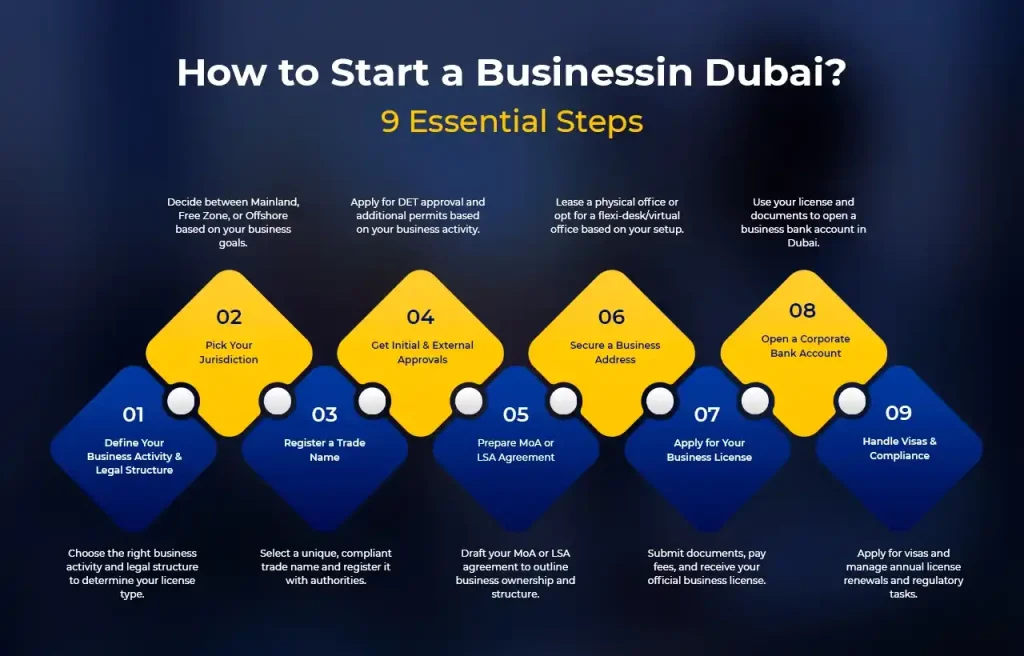
Your company formation in Dubai follows a clear path. Think of these nine steps as your roadmap to success. By following this guide, you will get a high-level view of the entire setup process, from the first decision you make to getting your final license and beyond.
Step 1: Finalize Your Business Activity & Legal Structure
First, you need to decide exactly what your business will do. Dubai offers thousands of approved business activities. Your choice here determines the type of license you get and the legal structure of your company, so picking the right activity from the official list is the foundation of your business setup.
Step 2: Choose Your Company Jurisdiction: Mainland, Free Zone, or Offshore
Next, you must pick where your company is based. You can choose a mainland, free zone, or offshore setup. This decision affects your ownership rights, tax obligations, and who you can do business with. Each option offers different benefits, so pick the one that fits your business goals.
Step 3: Select and Register Your Company Trade Name
You need to give your business a unique name and register it with the authorities. Your trade name cannot be offensive, use religious words, or be the same as another company’s name. Following these naming rules helps your registration go smoothly and avoids any delays in getting your license.
Step 4: Apply for Initial Approvals & External Approvals
Before you get your license, you need an initial approval from Dubai’s Department of Economy and Tourism (DET). This shows the government accepts your business idea. Depending on your activity, like food or healthcare, you may also need extra approvals from other specific bodies like the Dubai Municipality.
Step 5: Prepare Your Memorandum of Association (MoA) and Local Service Agent (LSA) Agreement
You must draft a Memorandum of Association (MoA), which is a document that outlines your company’s structure and shareholder details. For mainland companies offering professional services, you might need a Local Service Agent (LSA) agreement instead of an MoA with a local partner. These documents are legal requirements for your business registration.
Step 6: Establish a Physical Address or Virtual Office
Your business needs a registered address in Dubai for your license and official communications. You can lease a physical office, which is often required for mainland companies. Alternatively, many free zones allow you to use a more affordable flexi-desk or a legal virtual office to get started.
Step 7: Obtain Your Business License
After you submit all the needed documents and pay the required fees, you will get your business license. This is the last official step that makes your business a legal company in Dubai. The license is given by the Department of Economy and Tourism (DET) for mainland companies or by the specific free zone authority.
Step 8: Open a Corporate Bank Account
Once you have your business license, you can open a corporate bank account. This part can sometimes be tricky for new business owners because banks in Dubai have very strict rules. You will need to show them your trade license, your company’s official papers, and passport copies.
Step 9: Manage Visas and Post-Setup Compliance
With your business officially set up, you can now apply for visas for yourself, any business partners, and your staff. The UAE offers different visa options, including investor visas for owners and residence visas for employees. You will also need to handle ongoing tasks like renewing your license annually.
Source: The information presented here is based on guidelines from official government resources such as Invest in Dubai and the UAE Government’s official portal, along with business setup experts like Decisive Zone, as reflected in the cited sources.
Mainland vs. Free Zone vs. Offshore in 2025
To set up your company in Dubai, you first have to choose the right place for it. This choice will affect your business’s future. You have three main options: Mainland, Free Zone, and Offshore. Each has its own rules and benefits. Picking the right one depends on what your business does and who your customers are. It is a big decision that will shape your company’s growth and success.
Understanding the Core Differences
Let’s look at what makes each option different. A mainland company lets you trade anywhere in the UAE. A free zone company is great for international business with tax benefits. An offshore company is for holding assets and doing business outside the UAE. Knowing these differences will help you make the best choice for your new venture in Dubai.
Here is a table to help you compare them easily:
| Feature | Mainland Company | Free Zone Company | Offshore Company |
| Ownership | Up to 100% foreign ownership for most activities | 100% foreign ownership | 100% foreign ownership |
| Scope of Business | Trade directly within the UAE market and internationally | Operate within the free zone and internationally; needs a local distributor for mainland trade | Operate only outside the UAE |
| Corporate Tax | 9% on profits over AED 375,000 (SME Relief may apply) | 0% corporate tax for qualifying income | 0% corporate tax |
| Visa Eligibility | Yes, investor and employee visas available | Yes, visa eligibility often tied to office space | No visa eligibility |
| Office Requirement | Mandatory physical office required | Flexi-desk or physical office options available | Registered agent’s address only |
Who Should Choose a Mainland License?
A mainland license is perfect if you want to sell your products or services directly to customers anywhere in the UAE. This setup lets you work with both private companies and government offices without any restrictions. You can open your office anywhere in Dubai. This is the best choice for businesses like retail stores, restaurants, and local service providers that want full access to the local market.
Who Should Choose a Free Zone License?
A free zone license is a great option if your business focuses on international trade, like importing and exporting goods. There are over 40 free zones in the UAE, each designed for specific industries like tech, media, or finance. You get 100% ownership and can send all your profits back to your home country. If your income qualifies, you may also get a 0% corporate tax rate, which is a big advantage for startups and global companies.
Who Should Choose an Offshore Company?
An offshore company is different from the others because it is not meant for doing business inside the UAE. It is a legal tool used mainly for owning assets, like property or shares in other companies, and for managing international business activities.
It gives you privacy and protects your assets. This setup is ideal for entrepreneurs who need a legal entity for international trade or investment purposes but do not plan to operate within the local UAE market.
Sources: The information presented here is based on guidelines from official government resources such as the UAE Government’s official portal, along with business setup consultancies and legal firms like IFZA, Open a Dubai Company, and Global Law Experts, as reflected in the cited sources.
Cost of Setting Up Business in Dubai in 2025
Knowing the business setup cost in Dubai is a top concern for every entrepreneur. Many online guides have old or incomplete information, which can make budgeting difficult.

To help you plan properly, we have broken down the expected costs for setting up your company in 2025, giving you a clear picture of the investment needed for your new venture.
One-Time Setup Fees
When you first start your company, you will have several one-time payments. These fees cover the registration and administrative tasks needed to make your business official.
The costs can change depending on whether you choose a mainland or a free zone setup. Mainland companies often have higher setup costs but offer unrestricted access to the local market.
Here is a table with estimated one-time costs to give you an idea:
| Item | Mainland Cost (AED) | Free Zone Cost (AED) |
| Trade Name Reservation | 600 – 800 | 500 – 1,000 |
| Initial Approval | 150 – 250 | Included in package |
| License Registration | 15,000 – 30,000+ | 12,900 – 25,000+ |
| Establishment Card | 2,000 | 2,000 |
| E-Channel Registration | 2,500 | 2,500 |
Annual Renewal Costs
The expenses do not stop after the initial setup. You need to plan for costs that you will pay every year to keep your business running legally.
These include renewing your business license, paying for your office or flexi-desk lease, and any applicable sponsorship fees if you have a mainland company. Data protection fees might also apply depending on your business activities.
“Hidden” Costs to Factor In
Some expenses can be a surprise if you are not prepared for them. It is smart to budget for these “hidden” costs to avoid any issues later on. For example, you must provide mandatory medical insurance for all your employees.
You might also need to pay fees for help with opening a corporate bank account, as the process can be complex. Other costs include getting your documents officially attested and paying for visa medical tests and biometrics for your staff.
Tax, HR, and Reporting for Business Setup in Dubai

The 9% Corporate Tax Explained
The UAE has a corporate tax that you need to be aware of. All businesses must register with the Federal Tax Authority (FTA). The tax rate is 9% on profits over AED 375,000.
For smaller businesses, a relief scheme means you pay 0% tax on profits up to that amount. This tax applies to mainland companies and also to free zone companies that earn income from outside their qualifying activities.
Emiratisation (Nafis Program) Requirements
The UAE government has a program called Emiratisation to create more jobs for its citizens. If your company has 20 to 49 employees, you must hire at least one Emirati national by 2026.
Companies with 50 or more employees have a higher quota of 5%. If you do not meet these targets, you will face penalties, which increase each year. For example, the fine for not hiring an Emirati is AED 108,000 in 2025.
Mandatory Compliance Filings You Can’t Ignore
You also have some important reporting duties. You must identify and keep a record of your company’s Ultimate Beneficial Owner (UBO), which is the person who truly owns or controls it.
Additionally, some companies need to follow Economic Substance Regulations (ESR) to prove their business has a real presence in the UAE for financial periods through 2022. Finally, businesses in sectors like real estate and law must follow strict Anti-Money Laundering (AML) rules to prevent financial crimes.
Post-Launch Operations and Growth
After you get your license, your journey continues with running and growing your business. The steps you take now are just as important as the setup process. From managing your finances to finding support, here is what you need to focus on next for your business formation in Dubai.
Opening Your Corporate Bank Account: The Real Story
Opening a corporate bank account in Dubai can be a challenge for new companies. Banks have strict requirements.
To be ready, you should have a complete file with documents like your trade license, a detailed business plan, passport and visa copies for all shareholders, and proof of your address.
Being well-prepared makes the process much smoother and helps you avoid delays in getting your business banking ready.
Securing Funding and Support
You can find a lot of help in Dubai to grow your new business. The government offers support through programs like the Mohammed Bin Rashid Innovation Fund, which gives loan guarantees to innovative companies.
You can also join business incubators and accelerators like in5, Dtec, and Area 2071. These organizations provide mentorship, affordable office space, and chances to meet investors.
Planning for Company Liquidation
It is also wise to understand how to close a business properly if you ever need to. Closing a company in Dubai is a formal process called liquidation.
It involves passing a shareholder resolution, appointing an official liquidator to manage the process, clearing all your debts, and canceling all employee visas before the license is finally terminated.
Let us Help in Setting Up Your Business in Dubai

The setup process, especially with the 2025 regulations, can be complex. Companies like Decisive Zone specialize in helping entrepreneurs establish their businesses in Dubai smoothly.
They provide personalized services for mainland, free zone, and offshore company formation. Their teams assist with everything from getting a license and processing visas to opening a corporate bank account. This support allows founders to focus on growing their business instead of getting stuck on paperwork.
Frequently Asked Questions (FAQs)
How much does it cost to start a business in Dubai?
Initial setup costs typically range from AED 15,000 to AED 35,000, depending on your business license, jurisdiction, and visa requirements.
Can a foreigner own 100% of a business in Dubai?
Yes, 100% foreign ownership is available for most activities in mainland Dubai and is a standard feature for all free zone companies.
What is the first step in how to start a business in Dubai?
The first step is to finalize your business activity and legal structure, as this choice will determine your license type and jurisdiction.
Do I have to pay tax on my business in Dubai?
Yes, as of 2025, a 9% corporate tax applies to profits exceeding AED 375,000. However, many free zone businesses may have 0% tax on qualifying income.
How long does it take to get a business license in Dubai?
The process can take anywhere from a few days to a few weeks, depending on the business type, jurisdiction, and completeness of your documents.
Conclusion
Starting a business in Dubai in 2025 is a great goal that you can achieve with proper planning. This guide gives you a clear blueprint for success. Now, you can take the first step toward building your own successful company in one of the world’s most exciting cities.
The information presented here about business setup services is based on details provided by company formation specialists like Decisive Zone on their official website and in various business publications, as reflected in the cited sources.