
There are roughly four months left, and a significant number of UAE small businesses have not yet worked out what happens next.
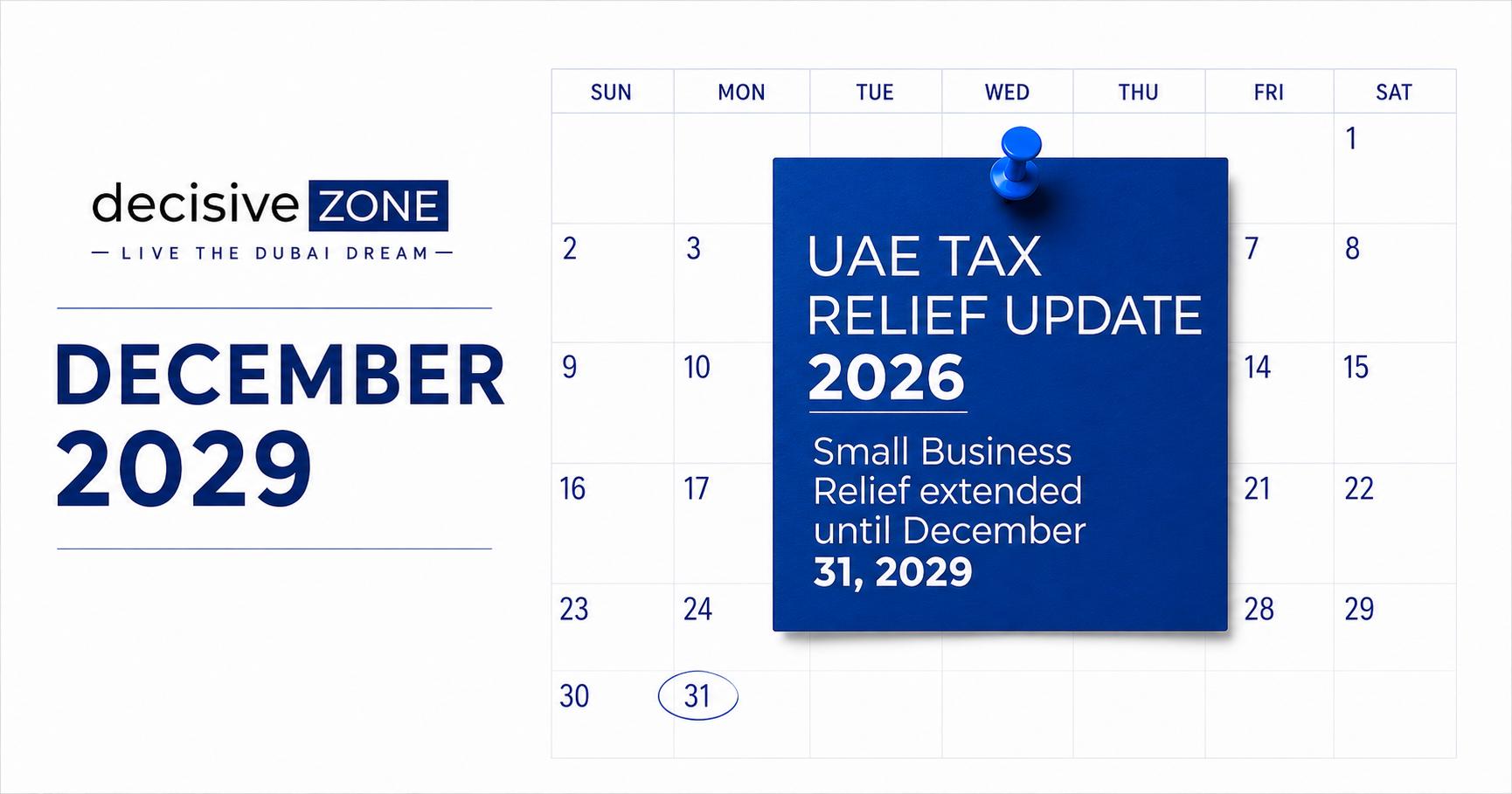
Small Business Relief allows companies with revenue at or below AED 3 million to elect zero taxable income. It has been the reason a large share of UAE SMEs have filed corporate tax returns showing nothing payable since the regime came into force. It is available only for tax periods ending on or before 31 December 2026.
After that date, it is gone. Nothing replaces it. Businesses that have been reporting zero move to the standard regime: 9% on taxable income above AED 375,000, with 0% below.
For many owners, the 2027 filing will be the first time UAE corporate tax appears as a real number on a real invoice. The size of that number is knowable today, and the businesses that calculate it now will handle the transition considerably better than those that wait.
Table of Contents
ToggleWhat the relief actually was, and why it was always temporary
Small Business Relief was introduced as a transitional measure. The intention was to give smaller businesses time to adjust to a corporate tax regime that had not previously existed in the UAE, rather than to create a permanent exemption for companies below a revenue threshold.
Two features of the relief are frequently misunderstood, and both matter as the deadline approaches.
The first is that it is an election, not an automatic entitlement. A business with revenue below AED 3 million does not receive the relief by default. It must be claimed explicitly at the point of filing, and late elections are not accepted. In the setups we review, this is one of the more common gaps – owners who believe they are covered because their revenue is under the threshold, and who have not actually made the election.
The second is that it cannot be combined with Qualifying Free Zone Person status. A free zone company benefiting from the 0% rate on qualifying income cannot also elect Small Business Relief. These are alternative positions, not complementary ones, and the choice between them has consequences that extend well past 2026.
Modelling the actual cost, rather than the headline
The rate is 9%, but the effective impact on a specific business depends on figures most owners have not needed to examine closely while the relief has applied.
Start with taxable income rather than revenue. The two are different, and the gap between them is where planning happens. Taxable income is calculated after deductible expenses, and the treatment of certain categories, including entertainment, related-party payments, interest and provisions, is not always intuitive.
Apply the AED 375,000 zero-rate band. A business with taxable income of AED 600,000 pays 9% on AED 225,000, not on the full amount. That distinction changes the outcome materially for smaller companies.
Then consider timing. Corporate tax is payable within nine months of the end of the relevant tax period. For a business with a December year end, the first payment under the standard regime falls due in September 2027. That is the cash flow date to plan around, not the filing date.
Running this calculation takes an afternoon. Discovering the answer during filing season, when advisory capacity across the market is stretched and your options have narrowed, takes considerably longer and costs more.
The records problem, which is larger than the tax
The most common gap we encounter is not tax planning. It is bookkeeping.
Under the relief, a business could arrive at a filing position without rigorous records, because the outcome was zero regardless. Under the standard regime, the outcome depends entirely on the quality of the numbers. Expenses must be properly categorised and substantiated. Revenue recognition must be consistent. Related-party arrangements must be identifiable.
Businesses that have been maintaining records adequate for a licence renewal rather than for a tax computation will find the difference significant.
There is also a compliance dimension that has tightened independently. The Federal Tax Authority has moved from establishing the corporate tax regime to enforcing it, and documentation requests have become more detailed. Records that would have passed without comment in the first filing cycle are being examined more closely now.
Cleaning up two years of records under deadline pressure is expensive. Doing it across four months, with a bookkeeper working normally, is not.
Whether restructuring is the answer, and when it is not
Owners looking at the end of the relief often ask whether a free zone structure solves the problem. Sometimes it does. Frequently it does not, and the analysis deserves care.
A free zone licence does not confer exemption from corporate tax. The 0% rate applies only to qualifying income earned by a Qualifying Free Zone Person, and that status must be earned and maintained annually. The conditions are adequate substance in the UAE, income derived from qualifying activities, compliance with the de minimis rule, arm’s length transfer pricing, and audited financial statements.
The de minimis rule permits non-qualifying revenue up to the lower of 5% of total revenue or AED 5 million. Exceeding it removes qualifying status for that period and the four that follow.
The critical point for most SMEs is that revenue from UAE mainland customers is generally non-qualifying. A business serving domestic clients will find that a free zone structure produces little tax benefit while adding audit costs, substance requirements and the annual risk of losing status. In that scenario, the mainland regime with its AED 375,000 band is usually the better position.
This is the assessment we work through with clients before recommending any change of structure, because the answer genuinely differs by business. Restructuring is a real option for companies whose revenue is international or falls within the qualifying activity list. It is not a general answer to the end of Small Business Relief, and it should not be sold as one.
Related-party arrangements need documenting now
Businesses operating more than one entity should treat this as a priority rather than an afterthought.
Any transaction between entities under common ownership must be on arm’s length terms. Management fees, intra-group loans, shared services, licensing arrangements and asset transfers are all within scope, and the obligation applies to SMEs rather than only to large groups.
Disclosure thresholds apply above specified values, and lower thresholds apply to transactions with connected persons, meaning owners, directors and their relatives.
While the relief applied, the practical consequence of undocumented arrangements was limited. From 2027 it is not. Documentation prepared at the time an arrangement is made carries far more weight than a justification constructed afterwards, and the window to prepare it contemporaneously closes with the year.
What a sensible four-month plan looks like
Confirm whether your business has actually been electing the relief, and that the election was made correctly in each period.
Calculate your 2027 position using current figures, and identify the payment date rather than only the filing date.
Bring your accounting records to a standard that supports a tax computation, and address any gaps in the current year rather than carrying them forward.
Review whether your structure still fits the business, being realistic about qualifying income if a free zone is under consideration.
Document related-party arrangements while they can still be documented contemporaneously.
Confirm your corporate tax registration is in order, since registration is a first-period obligation carrying penalties and remains a surprisingly common gap.
Most of this is work a business can do with its existing accountant. Where it becomes worth a second opinion is the structural question, particularly if a free zone move is being considered on the strength of a headline rate.
The honest position
This is a planning deadline rather than a crisis, and businesses that treat it as one will be entirely fine.
The companies that struggle will be those that arrive in 2027 without records capable of supporting a filing, or that restructured on the basis of a tax headline without checking whether their income actually qualifies, or that never made the election they assumed they were making.
None of those outcomes requires sophisticated planning to avoid. They require starting before December.
At Decisive Zone we work with SMEs across the mainland and free zones on exactly these decisions. If you would like your position reviewed while there is still time to act on the answer, our team is available to talk.